Pure magnesium chloride food grade benefits and uses


What are we discussing?
1-There are different types of magnesium
2-Dose magnesium chloride flakes or powder
3 Different Ways to Use Magnesium
4-Supplement and dosage information
5-Side effects and drug interactions
6. Why is almost everyone magnesium deficient?
7-Magnesium Functions
8-Links
There are different types of magnesium
Many people think magnesium is just one type. But there are different types.
The best absorbable magnesium is Magnesium Chloride.
NOTE: The recipe also needs to be well-made. You can choose a good magnesium supplement and still end up with a bad one.
Carolyn Dean has spent 20 years researching magnesium and shared her thoughts on certain magnesium supplements:
1-Magnesium oxide: poor absorption
2-Magnesium citrate: poorer absorption (cheap)
3-Magnesium chloride: is one of the most absorbable forms of magnesium
4-Magnesium Glycinate: less laxative and slightly better absorption
5-Magnesium L-threonate: said to be good for brain function, but more research is needed, according to Carolyn.
These three types of magnesium are used by naturopaths. Their magnesium supplement is of good quality.
1-Magnesium chloride: VERY well absorbed
(Dr. Carolyn Dean (Physician) + Robert Young (Biologist)
Their magnesium supplement recipe is highly regarded. And coincidentally, they both use magnesium chloride.
2-Magnesium malate
(Jigsaw Nutrition Expert - A Good Recipe)
3-Magnesium L-threonate
(Dr. Joseph Mercola (naturopath)

Magnesium chloride flakes or powder dosage
This magnesium salt tastes very salty, so you don't need much.
On the website of the National Institutes of Health (Office of Dietary Supplements), you'll find two blog posts about magnesium. These are two fact sheets for healthcare professionals.
Blog 1: Magnesium: Daily Recommendations + Dietary Sources of Magnesium + Discussion of Magnesium and Health. See article
Blog 2: Magnesium: The importance of magnesium + Daily recommended intake of magnesium + What happens to your health if you don't get enough magnesium + Magnesium interactions with medications (discussion of medications). See article .

Different ways to use magnesium
You can use magnesium internally or externally. If you're looking for a magnesium chloride supplement, you have several options, including:
Oral use
1-Magnesium chloride tablets: Take the tablet with a large glass of water.
2-Magnesium chloride liquid: Liquid form is also available. Liquid form should often be diluted in eight ounces (240 ml) of a drink of your choice. Avoid sugary drinks entirely. Use herbal teas or plain water or tea.
3-Magnesium chloride powder: Take a large glass of water and add the magnesium powder.
4-Magnesium chloride flakes: If the packaging of magnesium chloride flakes says "food grade," you can use them internally. You really don't need much. Half a teaspoon in a large glass of water. Take a large glass of water and add the magnesium flakes. Let the flakes dissolve briefly in the water.
5. Oral hygiene: You can make your own mouthwash and add magnesium, or you can make your own toothpaste and add magnesium.
External use
Magnesium is easily absorbed through the skin. It readily enters the bloodstream and thus the cells. Magnesium feels slightly greasy, which is why it's called an oil, but it's not an oil.
6-Magnesium chloride oil: apply to the skin
An oil form of magnesium that can be applied externally to the skin.
7-Magnesium chloride lotion or body butter: apply to the skin
A lotion form of magnesium that can be applied externally to the skin.
8-Magnesium compress: you can make your own compress.
9-Magnesium chloride: bath or foot bath
Another external way to use magnesium chloride salt is in full-body baths or foot baths. Daily magnesium requirements vary depending on age, gender, and health, so the appropriate dosage of magnesium chloride depends on several factors. 1 cup in a foot bath and 1-2 cups in a large bath.
Read the product recommendations carefully and always consult your naturopath for the best dosage.

The Gezond Wereldnieuws webshop sells Pure magnesium flakes and also Food Grade powder. Our magnesium chloride is from the Dead Sea in Israel. See webshop.

Supplement and dosage information
Magnesium flakes or powder: use
Dissolve 2 to 5 grams (half to a full teaspoon) in water or fresh juice and take once a day.
-1 full teaspoon = 5g (+/-600mg)
-1/2 teaspoon = 2gr (+/-300mg)
NB: the recommended daily amount is between 320 mg and 450 mg of elemental magnesium.
If you're sensitive, I might suggest starting with 1/4 teaspoon per day and working up to 1/2 teaspoon per day. Some people may develop loose stools if too much is taken at one time. Therefore, we recommend working up to a full dose and determining your ideal dose.
If you can tolerate it well, or are overweight and exercise frequently, 1 teaspoon may be fine. People who exercise frequently or experience chronic stress lose magnesium quickly. But always start with 1/4 or 1/2 teaspoon. A heaped teaspoon (about 5 grams) is equivalent to 600 mg of elemental magnesium.

Side effects and interactions
As with all magnesium supplements, magnesium chloride can cause side effects if you take too much. You don't really need much, but if you do take more than recommended, you'll experience side effects such as stomach upset and diarrhea.
These possible side effects can be reduced or avoided by not taking more than recommended and also by taking it with a meal.
Topical forms of magnesium are less likely to cause digestive side effects, but itching after applying magnesium oil is not uncommon. If this happens, the itching should subside once you wash it off.
You can try a magnesium lotion, which is often combined with other skin-soothing ingredients like aloe vera. Another option is to use magnesium flakes in a bath or foot soak.
The following drugs are known to interact with magnesium chloride:
demeclocycline
doxycycline
eltrombopag
lymecycline
minocycline
oxytetracycline
tetracycline
ciprofloxacin
fleroxacin
gemifloxacin
levofloxacin
moxifloxacin
norfloxacin
ofloxacin
penicillamine
rilpivirine
Talk to your doctor before taking magnesium chloride with other medications or supplements.

Why does almost everyone have a magnesium deficiency?
Magnesium is involved in over 300 processes in our body. A deficiency leads to a range of health problems.
Carolyn Dean (physician) wrote a book called "Magnesium: The Missing Link to Total Health ." Starting on page 113, she explains all the conditions that are linked to a magnesium deficiency. She discusses 68 conditions, explaining why they are related to a magnesium deficiency.
We have translated the 68 symptoms into Dutch and put them on a PDF.
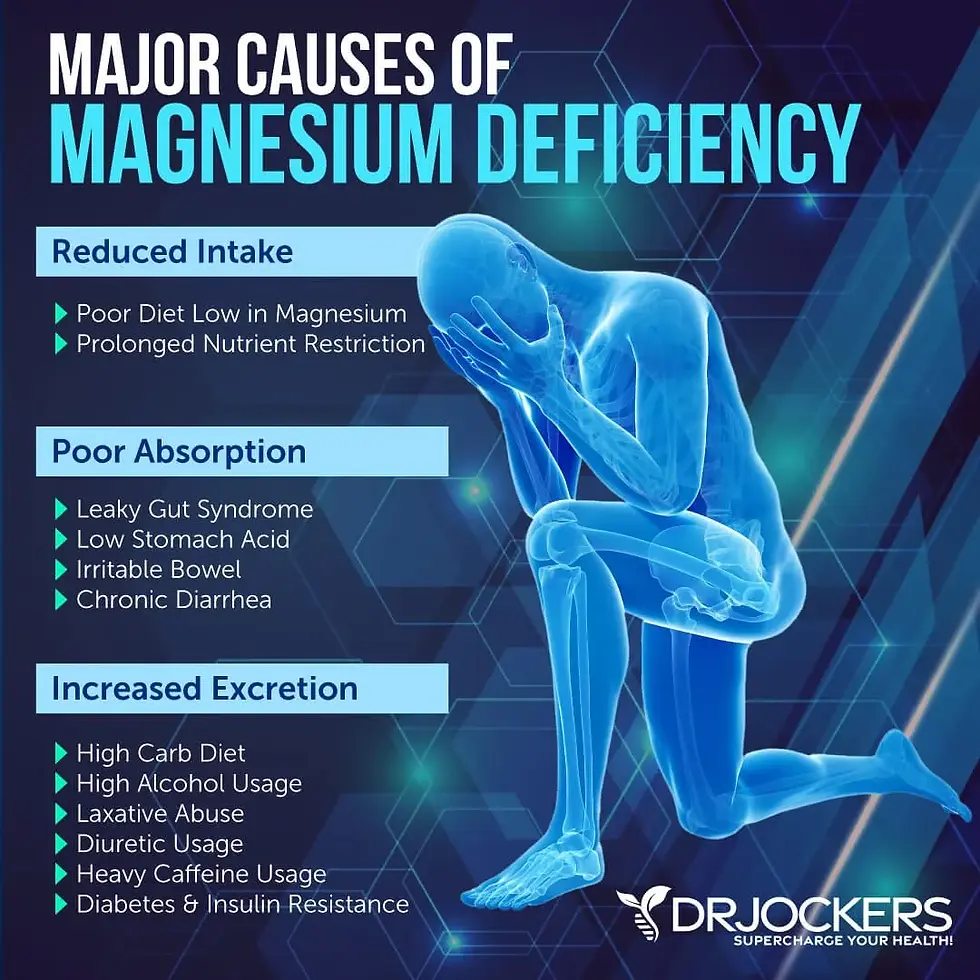
Various causes of a magnesium deficiency
Cause 1
Our soil is depleted of magnesium due to the pesticides they spray. In the soil there is
the calcium is always higher than the magnesium. Magnesium is more sensitive to pesticides. If then
If magnesium is depleted you can still get enough calcium.
Cause 2
There's also a problem with too much calcium in our diet from dairy products and calcium-fortified foods and juices. This is a problem because calcium and magnesium are antagonists. The more calcium in the body, the less magnesium.
They have a push-pull relationship .
Calcium and magnesium is a yin and yang
Calcium tenses the muscles and stimulates the nerves.
And magnesium relaxes the muscles and nerves.
When you have too much calcium in relation to magnesium, your muscles become stressed and nerves can become hyper-excitable, causing a range of symptoms such as high blood pressure, muscle spasms, palpitations, angina, and heart attack.
Magnesium must be present in sufficient quantities because it dissolves calcium. Without magnesium, calcium cannot dissolve. Calcium is present in your body, but not in the right place because it is not dissolved.
There are 2 problems if you get too much calcium in your body:
-People get typical illnesses from magnesium deficiency
-Calcification disorders: think of arteriosclerosis.
Cause 3
Our water isn't pure anymore either. It contains few minerals.
Cause 4
Eating too little food that contains magnesium.
Cause 5
People who experience chronic stress lose a lot of magnesium.
Cause 6
Athletes who take anabolic steroids also lose their magnesium rapidly.
Cause 7
People who take medications or get vaccinated. The chemicals and synthetic substances are primarily harmful and, secondly, disrupt the absorption of vitamins and minerals.
Cause 8
A diet with many toxic substances in their lifestyle such as: fluoride, phosphoric acid, processed sugar, lots of bread, additives, hormone disruptors, and other chemical and synthetic substances that are found in your food and care products.
Cause 9
You also lose a lot of magnesium during exercise. And athletes don't replenish it. 80% of magnesium supplements are of very poor quality.


Magnesium Functions
Here are 18 important functions of magnesium; there are many more
researched but we give the most important ones:
-Magnesium is responsible for the transmission of energy along the nerves
-Magnesium regulates muscle contractions
-Magnesium is important for muscle relaxation, followed by tension triggered by calcium
-Magnesium facilitates protein, carbohydrate and fat metabolism
-Magnesium maintains cellular mineral balance
-Magnesium influences all enzymatic processes
-Magnesium uses ATP as an energy source
-Magnesium creates energy for transfer, storage and use
-Magnesium reduces inflammatory reactions
-Magnesium helps your body detox
-Magnesium maintains normal cell membrane function
-Magnesium regulates body temperature
-Magnesium keeps your blood pressure in balance
-Magnesium maintains peripheral vascular resistance
-Magnesium influences good arterial function
-Magnesium regulates the parathyroid gland (important for bone health)
-Magnesium normalizes hormone secretion throughout the endocrine system
-Magnesium helps synthesize nucleic acids (DNA & RNA)
Imagine having a chronic magnesium deficiency. People then go to a conventional doctor who hasn't learned anything about nutrients. He then prescribes chemical medications that further deplete magnesium. They then say they can't cure your condition. They then recommend you take chemical pills for the rest of your life.

Sources
Dr. Josh Axe (naturopath)
Dr. David Jockers (naturologist).
What Is Magnesium Chloride?


Comments